How Much Does Yacht Management Cost?
Quick Answer
For a 20-meter yacht, expect to pay €15,000–40,000 per year for a full management package. For a 40-meter superyacht, that number is €150,000–500,000. The range is wide because "management" means very different things depending on who's quoting you — always compare scope, not just the headline fee.
of annual operating budget (typical range)
Yacht management is one of the least discussed — yet most significant — ongoing costs of ownership. Owners often focus on crew, fuel, and maintenance when budgeting, then are surprised by five- or six-figure management fees. This guide breaks down exactly what management companies charge, what you get for that fee, and how to decide whether professional management makes financial sense for your situation.
The Two Main Fee Models
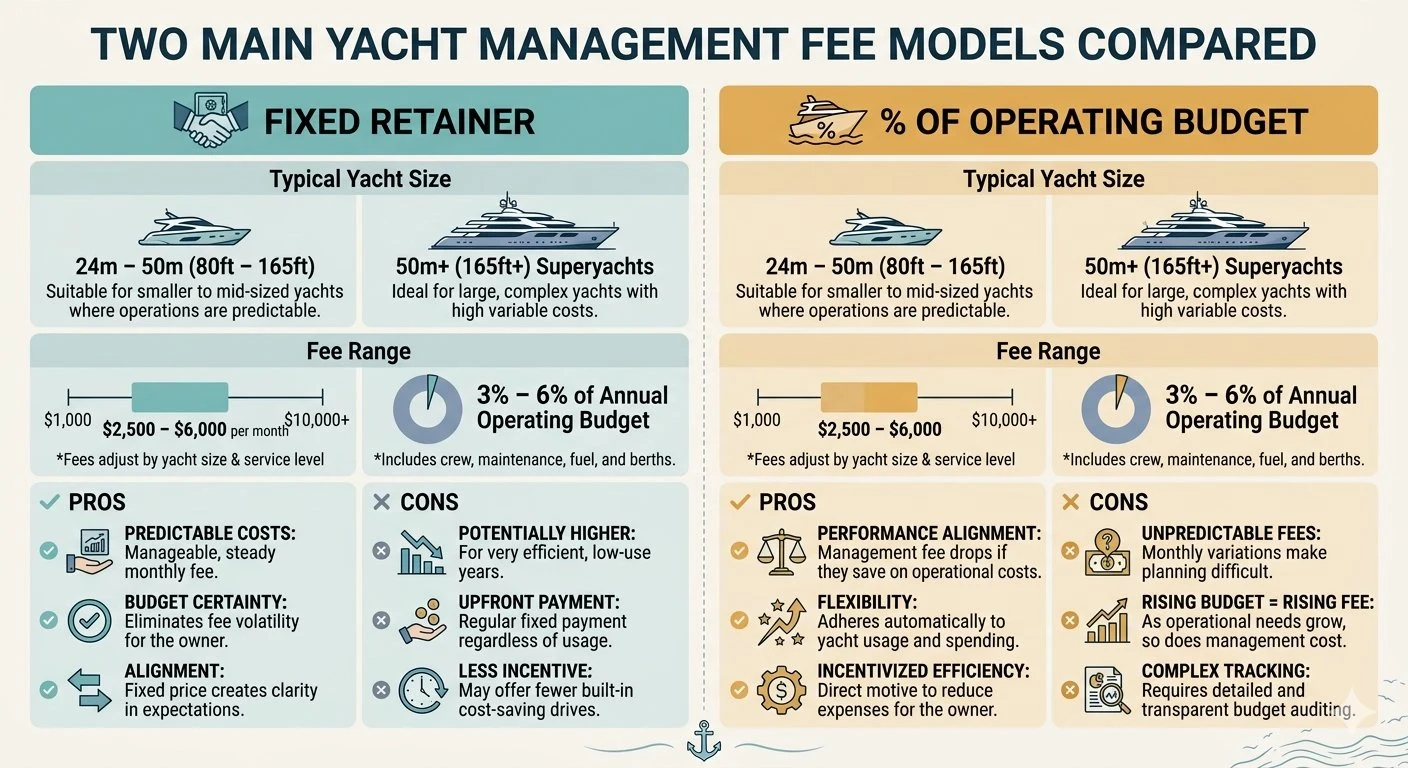
Most management companies use one of two structures, sometimes combined.
Fixed monthly retainer
A flat fee regardless of how much activity there is on the yacht. Typical for smaller vessels (under 24 meters) with 2–3 crew. The advantage is predictability. The downside: the company has little financial incentive to optimize your operating costs, since their fee doesn't change either way.
For a yacht in the 15–24 meter range with a captain and one or two crew, a fixed retainer typically runs €1,500–3,000 per month (€18,000–36,000 per year). What's covered: technical oversight, administrative support, crew payroll processing, and regulatory compliance. Charter marketing and accounting are often add-ons.
Percentage of operating budget
More common for mid-size and large yachts. The management fee is calculated as a percentage of the yacht's total annual operating spend — typically 5–10%, with 7% being common for 24–40 meter vessels.
On a 30-meter yacht with annual operating costs of €1.2 million, a 7% management fee equals €84,000 per year. The company's income scales with your spending, which creates a different incentive structure than a retainer — worth thinking about when you negotiate.
⚠️ Charter management fees are separate
Charter management is typically charged as a 15–20% commission on gross charter revenue, on top of the base management fee. A yacht generating €400,000/year in charters pays an additional €60,000–80,000 in charter management fees.
Typical Fee Ranges by Yacht Size
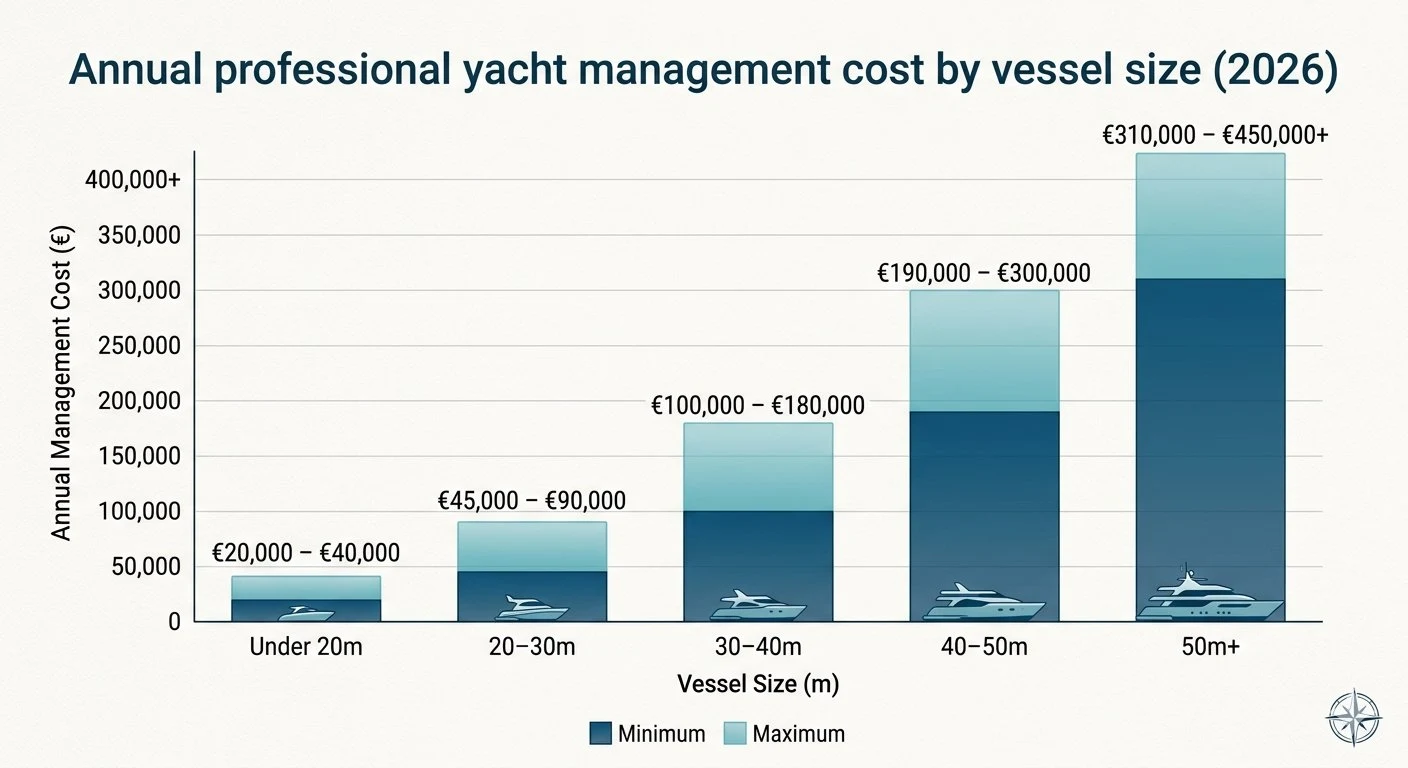
| Yacht size | Crew | Fee structure | Annual cost |
|---|---|---|---|
| Under 20m | 1–2 | Fixed retainer | €12,000–25,000 |
| 20–30m | 2–4 | Fixed or hybrid | €25,000–80,000 |
| 30–40m | 5–8 | % of operating budget | €70,000–180,000 |
| 40–50m | 10–15 | % of operating budget | €180,000–350,000 |
| 50m+ | 15–25+ | % of operating budget | €300,000–600,000+ |
One-time setup fees are common and often non-negotiable. Expect to pay €1,500–5,000 to establish crew payroll, flag state registrations, and the management company's administrative systems at the start of the relationship.
Calculate Your Total Annual Costs First
Before evaluating management fees, know your full operating budget. Our calculator gives you a complete cost breakdown including crew, maintenance, insurance, fuel and dockage.
Use Free Yacht Cost Calculator →What Yacht Management Actually Covers
There's no industry-standard definition of "full management," which is the main reason proposals are hard to compare at face value. Always read the scope of services section carefully.
Technical management
Routine maintenance scheduling, yard period coordination, refit oversight, spare parts procurement, compliance with flag state survey requirements. Usually included in any base package. The value shows up in supplier relationships — established companies negotiate better rates on parts, fuel, and labor than you'd get independently.
Financial administration
Budget preparation, monthly expense reports, invoice approval and payment, petty cash reconciliation, APA accounting for charter yachts. Some companies include basic bookkeeping; others charge separately at €500–1,500 per month depending on transaction volume.
Crew management
Payroll processing, employment contracts (MLC-compliant SEAs), medical and travel insurance coordination, visa and certification compliance, and crew recruitment when there's turnover. Payroll processing is often charged per payment sent ($65–100 per transaction). Permanent crew placement runs 10% of first-year salary; temporary placements typically 25% of earnings.
Charter management (when applicable)
Active marketing to brokers and at boat shows, negotiation of charter contracts, guest coordination, provisioning logistics, post-charter APA reconciliation. Commission-based at 15–20% of gross revenue — charged on top of the base management fee.
What's Usually Not Included
The following are commonly billed as pass-through costs or separate service fees:
- Crew salaries (you pay crew directly; management processes payroll)
- Fuel, provisions, mooring fees (passed through at cost)
- Major repairs, refits, and yard periods (managed but not absorbed)
- Insurance premiums (arranged by management, paid by owner)
- Flag state fees and survey costs
- Emergency call-out fees ($500–2,000/incident outside business hours)
⚠️ Always ask about vendor rebates
Some management companies receive volume rebates from fuel suppliers, chandleries, and marinas — and keep them rather than passing savings to owners. Insist on a clause requiring full disclosure of any rebates received on your behalf.
Is Professional Management Worth It?
For yachts under 15 meters with owner-operators who are on board regularly, probably not. The administrative overhead is manageable, and the savings from DIY procurement are modest.
Above 20 meters with professional crew, the calculation changes. The compliance burden becomes real — MLC requirements, flag state surveys, commercial charter licensing if applicable. Missing a survey or having a crew contract issue can mean the yacht can't operate commercially, which is a much bigger cost than the management fee.
Management is worth more the less time you personally spend on the boat, and the more complex the operation. For a private family yacht used six weeks per year in a home port, the cost-benefit is tighter.
Real Example: 95ft Motor Yacht, Mediterranean Base
Annual operating budget: $980,000
Management fee (10%): $98,000/year
Charter management (18% of $400K revenue): $72,000/year
Total management cost: $170,000/year
Offset by: charter income of $400,000 and vendor savings of ~$38,000 via bulk purchasing. Net management cost after offsets: ~$132,000 — or 13.5% of gross operating spend.
How to Evaluate Management Proposals
- Ask what happens when the relationship ends. Some contracts include substantial exit fees or require 6–12 months notice. The exit structure tells you a lot about how confident the company is in retaining clients through service quality rather than contractual lock-in.
- Get references from similar-size yachts. Management companies with strong reputations provide these without hesitation.
- Understand the markup policy on pass-through costs. Some companies add 5–15% to parts, fuel, and labor on top of the management fee. Either model is defensible, but you need to know which one you're in.
- Get at least three competing quotes. Management pricing is negotiable, especially for larger yachts.
- Build in a 90-day exit clause. Avoid being locked in if the relationship isn't working.
✅ Key takeaway
Management fees of 5–10% of operating budget sound significant, but for most owners the real net cost after savings is closer to 3–7%. For absentee owners and first-time superyacht owners, it's the single most cost-effective investment you can make in protecting the asset.
Calculate Your Complete Ownership Costs
Include management, crew, insurance, fuel and maintenance in one accurate estimate. Takes 5 minutes, covers 40–300ft vessels.
Use Free Yacht Cost Calculator →