What is the 10% Rule for Yachts? Complete Owner's Guide 2026
Quick Answer: What is the 10% Rule?
The 10% rule for yachts states that annual operating costs typically equal 10-15% of the vessel's market value. For example, a $10 million yacht costs approximately $1-1.5 million per year to operate, including crew salaries, dockage, insurance, fuel, maintenance, and other recurring expenses.
Table of Contents
- What is the 10% Rule for Yachts?
- The 10% Rule Formula Explained
- Why the 10% Rule Matters for Buyers
- What's Included in the 10%?
- Real-World Examples by Yacht Size
- What if Your Costs Are Below 10%?
- What if Your Costs Exceed 15%?
- Exceptions to the Rule
- How to Calculate Your Specific Costs
- Frequently Asked Questions
What is the 10% Rule for Yachts?
The 10% rule is a widely-accepted industry standard used by yacht brokers, management companies, and experienced owners to estimate annual operating costs. It provides a simple formula: expect to spend 10-15% of your yacht's current market value each year on operating expenses.
This guideline has proven remarkably consistent across the yachting industry for decades, from 60-foot sport cruisers to 200-foot superyachts. While individual circumstances vary, the 10% rule serves as a reliable starting point for financial planning and helps prevent the most common mistake new yacht owners make: underestimating ongoing costs.
💡 Key Insight
The 10% rule applies to operating costs only and does not include the initial purchase price, sales tax, major capital improvements, or debt service on yacht financing. Think of it as your annual "running cost" once you own the vessel.
The 10% Rule Formula Explained
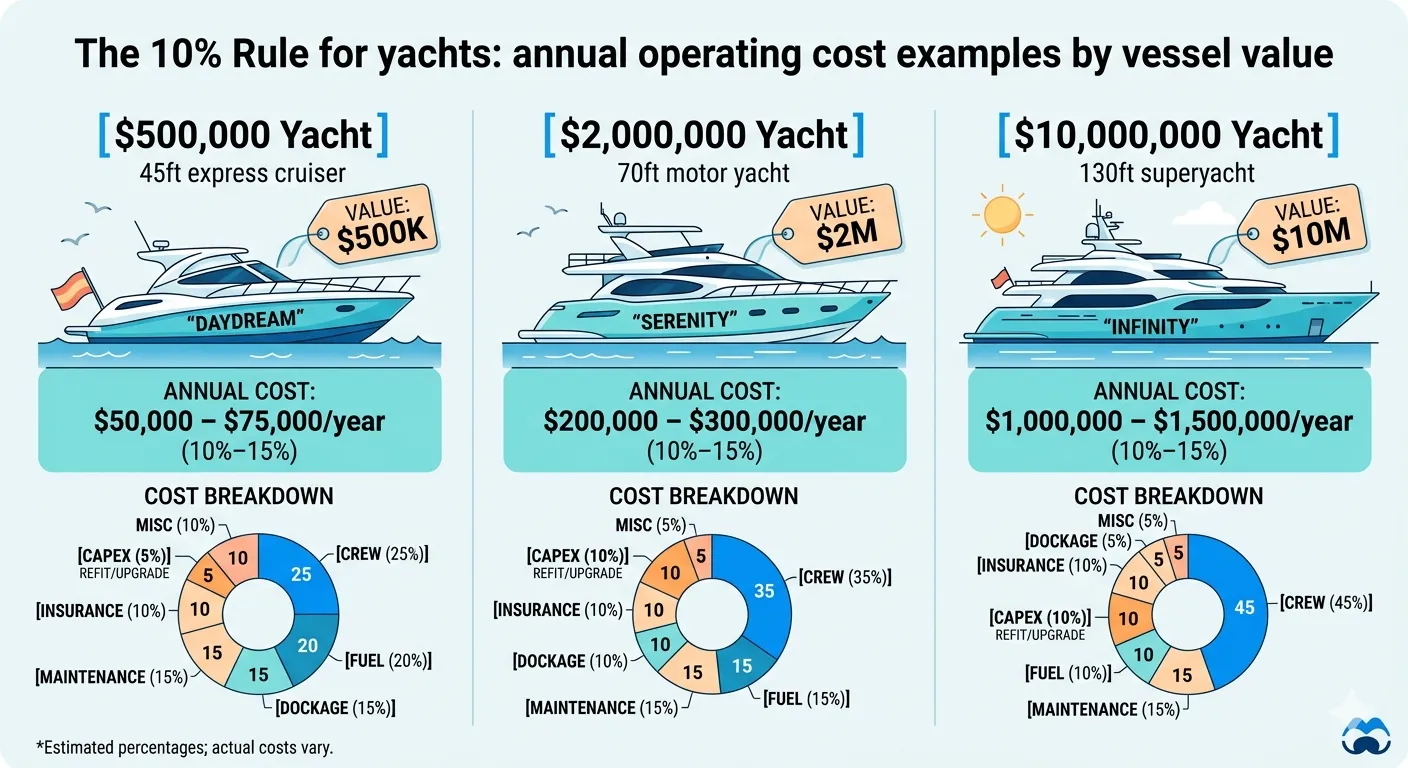
Three real examples of the 10% Rule in action — from a 45ft cruiser to a 130ft superyacht, with cost breakdown by category.
The calculation is straightforward:
Formula
Annual Operating Cost = Yacht Market Value × (10% to 15%)
Why the range of 10-15%? The percentage varies based on several factors:
- Yacht age: Older vessels require more maintenance (closer to 15%)
- Usage intensity: More cruising days increase fuel and maintenance costs
- Crew size: Larger crews push costs toward the upper range
- Regional factors: Mediterranean operations cost more than Caribbean
- Maintenance approach: Premium concierge service vs. standard preventive maintenance
- Vessel complexity: Expedition yachts cost more than simple motor yachts
📊 Example Calculation
Scenario: 80-foot motor yacht, 5 years old, Mediterranean-based
- Current market value: $5,000,000
- Estimated annual cost at 12%: $600,000/year
- Monthly budget: $50,000
- If cruising 100 days/year: $6,000/day
Why the 10% Rule Matters for Buyers
The 10% rule serves as a financial reality check before purchase. Many first-time yacht buyers focus exclusively on the purchase price without fully understanding the ongoing financial commitment. This leads to three common problems:
1. Budget Shock in Year One
Buyers who budget only $500,000 for a $10 million yacht are stunned when actual costs reach $1.2 million. Suddenly they're making difficult choices between qualified crew, proper maintenance, and comprehensive insurance.
2. Deferred Maintenance
Under-resourcing maintenance leads to compounding problems. A $20,000 repair today becomes a $100,000 emergency next season. Deferred maintenance also significantly reduces resale value.
3. Crew Turnover
Inadequate crew compensation leads to turnover, which disrupts operations and requires costly recruitment. Quality crew protect your investment and ensure safety—they're worth proper compensation.
⚠️ Warning Sign
If a yacht management company or broker suggests you can operate "well below 10%" without detailed justification, be skeptical. Either they're inexperienced or trying to close a sale. Sustainable yacht ownership requires realistic budgeting.
What's Included in the 10%?
The 10-15% covers all recurring annual operating expenses. Here's the typical breakdown:
| Expense Category | % of Total Cost | Notes |
|---|---|---|
| Crew Salaries & Benefits | 30-40% | Largest expense; includes health insurance, training, uniforms |
| Maintenance & Repairs | 20-25% | Routine maintenance plus unexpected repairs |
| Dockage & Mooring | 10-15% | Varies dramatically by region ($30-120/ft/month) |
| Insurance | 8-12% | Hull, machinery, P&I, crew coverage |
| Fuel | 8-15% | Highly variable based on usage |
| Provisioning & Supplies | 5-8% | Food, beverages, linens, consumables |
| Communications & IT | 2-3% | Satellite internet, phones, systems |
| Management & Legal | 2-3% | Professional yacht management fees |
| Miscellaneous | 3-5% | Registration, permits, winterization, etc. |
| TOTAL | 100% | = 10-15% of yacht value |
Real-World Examples by Yacht Size
Let's examine how the 10% rule applies across different yacht sizes with realistic 2026 market values:
🚤 60-Foot Sport Yacht
- Market Value: $1,500,000
- Annual Cost (12%): $180,000/year
- Monthly Budget: $15,000
- Typical Crew: Owner-operated or 1-2 crew
- Usage: Weekend cruising, seasonal use
⛵ 80-Foot Motor Yacht
- Market Value: $5,000,000
- Annual Cost (12%): $600,000/year
- Monthly Budget: $50,000
- Typical Crew: 3-4 full-time crew
- Usage: Extended cruising, charter operations
🛥️ 120-Foot Superyacht
- Market Value: $15,000,000
- Annual Cost (13%): $1,950,000/year
- Monthly Budget: $162,500
- Typical Crew: 6-8 full-time crew
- Usage: Year-round global cruising
🚢 180-Foot Megayacht
- Market Value: $50,000,000
- Annual Cost (14%): $7,000,000/year
- Monthly Budget: $583,333
- Typical Crew: 12-16 full-time crew
- Usage: Full-time luxury operations
What if Your Costs Are Below 10%?
Operating costs below 10% can indicate either excellent management or dangerous under-resourcing. Here's how to tell the difference:
Legitimate Reasons for Below-10% Costs:
- Minimal usage: Yacht docked most of the year with skeletal crew
- Owner-operated: Owner serves as captain, reducing crew costs 40%+
- Low-cost region: Caribbean-based vs Mediterranean saves 30-40%
- Newer vessel: 1-3 year old boats require minimal maintenance
- Mooring vs marina: Can reduce dockage costs by 60-70%
Warning Signs of Under-Resourcing:
- Crew compensation below market: Leads to turnover and safety issues
- Reactive vs preventive maintenance: "Fix when broken" costs more long-term
- Minimal insurance coverage: Catastrophic financial risk
- Deferred upgrades: Systems aging without replacement
- No refit reserve: Major expense shock every 5-7 years
💡 Industry Reality
Experienced yacht managers say: "You can run a yacht below 10%, but you can't run it well below 10%." Costs of 8-9% are achievable with good management, but anything below 8% raises red flags about vessel condition and long-term viability.
What if Your Costs Exceed 15%?
Costs above 15% suggest either premium service levels or operational inefficiency. Both are valid, but you should understand which applies:
Justifiable Reasons for 15%+ Costs:
- Heavy usage: 250+ days at sea burns significantly more fuel
- Premium crew: Master mariners and Michelin-trained chefs command premium salaries
- Concierge maintenance: White-glove service costs 50% more than standard
- Worldwide navigation: Insurance costs 40% more than coastal-only
- Charter operations: Higher wear-and-tear and enhanced service standards
- Older vessels: 20+ year old yachts require 15-18% for proper upkeep
Signs of Operational Inefficiency:
- Overstaffing: More crew than necessary for vessel size
- Poor vendor management: Paying retail instead of negotiating
- Excessive fuel consumption: Running at higher speeds than necessary
- Frequent emergency repairs: Result of deferred preventive maintenance
- Premium dockage year-round: When mooring would suffice part-time
💡 Optimization Opportunity
If your costs exceed 15%, consult with a professional yacht management company for an operational audit. They can typically identify 10-20% in potential savings without compromising service quality or safety.
Exceptions to the Rule
While the 10% rule is broadly applicable, certain situations create legitimate exceptions:
1. Brand New Build (First 2 Years)
New yachts under warranty often run at 6-8% because:
- Warranty covers most maintenance and repairs
- No deferred maintenance issues
- Modern systems require less service
- Efficient engines reduce fuel costs
Note: Budget increases to normal 10-15% after warranty expires.
2. Long-Term Storage (Mothballed)
Yachts in long-term storage with minimal or no crew can operate at 3-5% covering:
- Storage fees
- Basic insurance
- Periodic systems checks
- Registration and permits
Note: Bringing vessel back to operational status requires significant investment.
3. Charter Income Offset
Yachts earning charter income may show net costs below 10% but gross costs still 12-15%:
- 10-15 weeks charter per year
- Gross income: $300,000-500,000
- Charter expenses: 30% of income
- Net cost reduction: 20-40% of base operating budget
4. Sailing Yachts vs Motor Yachts
Sailing yachts often operate at 8-12% (lower end) because:
- Dramatically lower fuel consumption
- Simpler systems and less machinery
- Often owner-operated with smaller crew
- Lower insurance premiums
How to Calculate Your Specific Costs
While the 10% rule provides a good starting estimate, calculating your actual costs requires accounting for your specific circumstances:
Step 1: Determine Your Yacht's Current Market Value
Not the purchase price—the current fair market value. Yachts depreciate 10-15% in the first year, then 5-10% annually thereafter. Consult recent sales of comparable vessels.
Step 2: Apply the Appropriate Percentage
Consider these factors when choosing your percentage (10-15%):
- Add 1-2% for vessels over 15 years old
- Add 1-2% for Mediterranean vs Caribbean operations
- Add 0.5-1% for extensive cruising (200+ days/year)
- Subtract 1-2% for newer vessels (under 5 years)
- Subtract 0.5-1% for minimal usage (under 50 days/year)
Step 3: Calculate Monthly and Daily Budgets
Break down your annual budget for easier planning:
- Monthly budget: Annual cost ÷ 12
- Daily operating cost: Annual cost ÷ 365
- Cost per sea day: Annual cost ÷ actual cruising days
💰 Calculate Your Exact Yacht Costs
Get a personalized cost breakdown for your specific yacht with our professional calculator. Takes 5 minutes to complete.
Use Free Calculator →Frequently Asked Questions
Does the 10% rule apply to both purchase and operation?
No. The 10% rule applies only to annual operating costs, not the purchase price. The purchase price is a separate one-time investment (plus sales tax), while the 10% represents your yearly ongoing expenses.
Can I reduce costs by not using professional crew?
Potentially, but with significant tradeoffs. Owner-operated vessels save 30-40% on crew costs but require:
- Proper certifications and experience
- Significant time commitment
- Reduced cruising flexibility
- Insurance companies often require professional crew for vessels 60ft+
How does the 10% rule compare to other vessel types?
The percentage varies by vessel category:
- Small boats (under 40ft): 5-8% of value
- Motor yachts (40-80ft): 10-12%
- Superyachts (80-150ft): 12-15%
- Megayachts (150ft+): 13-18%
- Sailing yachts: 8-12% (lower fuel costs)
Should I budget the minimum (10%) or maximum (15%)?
Budget for 12-13% initially. This middle ground provides:
- Adequate cushion for unexpected expenses
- Proper preventive maintenance funding
- Competitive crew compensation
- Financial flexibility for opportunities (extended cruises, charters)
You can always spend less, but budgeting too tight from the start creates stress and operational problems.
Does vessel age significantly impact the percentage?
Yes. Age affects costs through:
- 0-5 years: Often 10-11% (warranty coverage, modern systems)
- 5-10 years: Typically 11-13% (post-warranty, normal operations)
- 10-15 years: Often 13-15% (aging systems, more frequent repairs)
- 15+ years: Can reach 15-18% (major systems nearing replacement)
Can charter income reduce my net costs below 10%?
Yes, charter income can offset 20-50% of operating costs, but remember:
- Gross costs remain 12-15% of value before charter income
- Charter operations increase wear-and-tear
- Insurance costs slightly higher for charter use
- Management fees reduce net charter income
- IRS requires proper business structure for tax benefits
What if I can't afford 10% annually?
If 10% of your intended yacht's value exceeds your comfortable budget, consider:
- Purchasing a less expensive yacht where 10% fits your budget
- Fractional ownership or yacht clubs for occasional access
- Charter when desired rather than ownership
- Delay purchase until your budget accommodates proper operation
Buying more yacht than you can afford to operate leads to financial stress, deferred maintenance, and often forced resale at a loss.
✅ Key Takeaway
The 10% rule is not arbitrary—it represents decades of industry experience about what's required for safe, sustainable yacht ownership. Use it as your starting point for financial planning, then adjust based on your specific circumstances. When in doubt, budget toward the higher end (13-15%). You can always spend less, but financial surprises are far more stressful than having a cushion.