Yacht Flag Registration Guide 2026: Choosing the Right Flag State
Quick Answer: Which Flag is Best?
The best yacht flag depends on your specific situation. Cayman Islands offers prestige and strong regulations. Marshall Islands provides flexibility and lower costs. Malta is ideal for EU cruising. US flag is required for domestic charter. Consider tax implications, crew nationality, cruising grounds, and charter operations when selecting your flag state.
Yacht flag registration is one of the most important decisions you'll make as an owner, with significant implications for taxes, crew employment, insurance costs, and where you can legally operate. Yet it's often overlooked until late in the purchase process.
This comprehensive guide compares the major yacht registration jurisdictions in 2026, breaking down costs, requirements, advantages, and which flag makes sense for different ownership scenarios.
Understanding Yacht Flag Registration
A yacht's flag state is the country where the vessel is registered and whose maritime laws govern the yacht. Think of it as the yacht's "nationality" for legal and regulatory purposes.
Why Flag State Matters
- Tax obligations: Some flags impose income tax, VAT, or tonnage tax; others don't
- Crew employment laws: Determines labor regulations, minimum wage, and crew nationality requirements
- Insurance costs: Insurers offer better rates for yachts flagged in well-regulated jurisdictions
- Operational requirements: Safety inspections, documentation, and compliance standards
- Charter eligibility: Some regions require specific flags for commercial operations
- Cruising flexibility: Access to certain waters and port privileges
💡 Key Principle
Your yacht's flag doesn't need to match your citizenship or where you keep the yacht. You can be a US citizen with a Marshall Islands-flagged yacht based in Florida. However, each flag has specific requirements and implications you must understand.
Top Yacht Flag States Compared
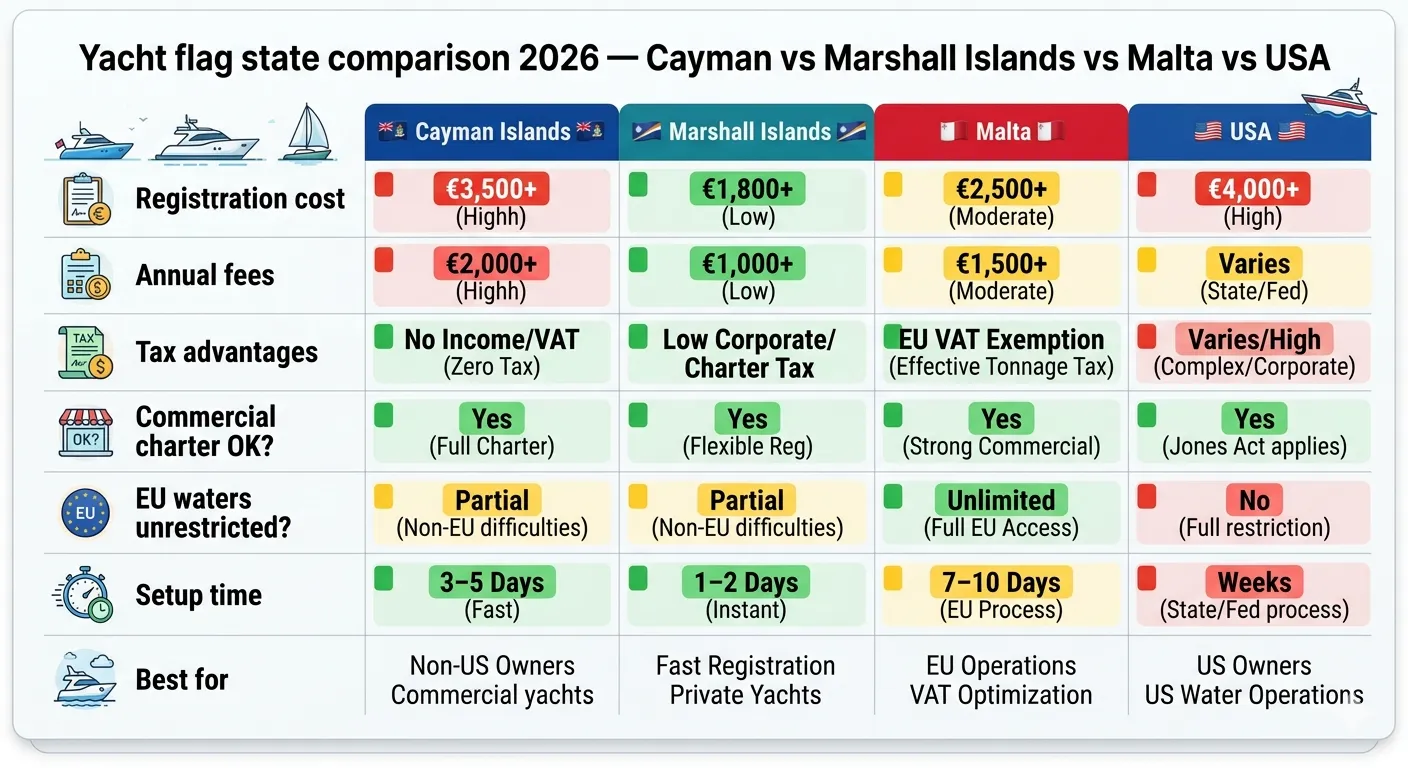
Side-by-side comparison of the four main flag states — registration costs, tax advantages, EU access, and setup time.
| Flag State | Annual Cost | Best For | Key Advantage |
|---|---|---|---|
| Cayman Islands | $8,000-$15,000 | Prestige & charter | Red Ensign Group, strong reputation |
| Marshall Islands | $5,000-$10,000 | Flexibility & cost | Low cost, minimal restrictions |
| Malta | $10,000-$18,000 | EU operations | EU flag with tax benefits |
| United States | $3,000-$8,000 | US charter | Required for US domestic charter |
| British Virgin Islands | $6,000-$12,000 | Caribbean cruising | Caribbean access, Red Ensign |
Cayman Islands Flag: The Premium Choice
🇰🇾 Cayman Islands Registration
Annual Costs: $8,000-$15,000
What's Included:
- Initial registration: $3,000-5,000
- Annual tonnage tax: $2,000-6,000 (based on net tonnage)
- Annual renewal: $1,000-2,000
- Surveyor inspection: $2,000-4,000
✅ Advantages
- Part of prestigious Red Ensign Group
- Strong maritime regulations and safety standards
- Well-respected by insurers (lower premiums)
- No income tax or VAT for non-residents
- Excellent for charter operations
- Professional registry administration
⚠️ Considerations
- Higher annual costs than alternatives
- Stricter compliance requirements
- More frequent inspections required
- Initial registration takes 4-6 weeks
Best For: Owners who prioritize reputation, plan to charter commercially, cruise internationally, or want the prestige of a Red Ensign Group flag.
Marshall Islands Flag: The Flexible Option
🇲🇭 Marshall Islands Registration
Annual Costs: $5,000-$10,000
What's Included:
- Initial registration: $2,000-4,000
- Annual renewal: $2,000-4,000
- Documentation fees: $1,000-2,000
✅ Advantages
- Lowest cost major yacht flag
- No income tax or VAT
- Flexible crew employment regulations
- Fast registration (2-3 weeks)
- Minimal ongoing compliance requirements
- Widely accepted by insurers
- No physical inspections required for private yachts
⚠️ Considerations
- Less prestigious than Red Ensign flags
- Some Caribbean nations charge higher port fees
- May face additional scrutiny in certain ports
- Not ideal for EU-based operations
Best For: Private yacht owners who cruise internationally but not primarily in EU waters, want to minimize costs, and don't need charter licensing in restrictive jurisdictions.
Malta Flag: The EU Gateway
🇲🇹 Malta Registration
Annual Costs: $10,000-$18,000
What's Included:
- Initial registration: $4,000-7,000
- Annual tonnage tax: $3,000-8,000
- Compliance & documentation: $3,000-5,000
✅ Advantages
- EU flag with full member benefits
- Excellent for Mediterranean cruising
- Strong reputation and safety standards
- Favorable tax regime for yacht owners
- Tonnage tax option (predictable annual cost)
- Well-established yacht registry
⚠️ Considerations
- Higher costs than Marshall Islands
- Stricter EU regulations apply
- VAT complexities for EU cruising
- More documentation required
- Longer registration process (6-8 weeks)
Best For: Owners who primarily cruise Mediterranean and European waters, want EU flag benefits, or need to optimize VAT treatment for yachts based in Europe.
United States Flag: For Domestic Operations
🇺🇸 US Coast Guard Documentation
Annual Costs: $3,000-$8,000
What's Included:
- USCG documentation: $100-300 annually
- State registration (varies): $200-500
- Compliance & legal: $2,000-4,000
- Tax implications vary by state
✅ Advantages
- Required for US domestic charter
- Lowest documentation costs
- Simplified US port clearance
- Financing often easier with US flag
- Familiar legal framework
⚠️ Considerations
- Strict crew nationality requirements (75% US citizens)
- Jones Act restrictions for charter
- Higher crew costs due to US labor laws
- Complex state tax implications
- Not ideal for international cruising
- Limited crew pool for large yachts
Best For: Yachts operating primarily in US waters, those required to charter domestically under Jones Act, or owners who prioritize US legal jurisdiction.
⚠️ US Flag Crew Requirement Reality
The biggest drawback of US flagging is crew restrictions. You need 75% US citizens in crew positions, which dramatically limits your hiring pool and increases costs. For a 100ft yacht requiring 5 crew, finding four qualified American yacht crew is challenging and expensive. This is why many US owners choose foreign flags even when keeping their yacht in American waters.
Flag Selection Decision Framework
Choose Cayman Islands Flag If:
- You plan commercial charter operations globally
- Yacht value exceeds $5M and prestige matters
- You want the best insurance rates
- You cruise internationally to major yachting destinations
- You're willing to pay premium for top-tier registry
Choose Marshall Islands Flag If:
- Minimizing costs is a priority
- You want maximum crew employment flexibility
- You cruise primarily Caribbean and Americas
- Private use (non-charter) is your primary purpose
- You want simple, fast registration process
Choose Malta Flag If:
- You primarily cruise Mediterranean
- You want EU flag benefits and VAT optimization
- Your yacht is based in European waters
- You need EU-compliant registration for charter
Choose US Flag If:
- You must charter in US waters (Jones Act requirement)
- You cruise exclusively domestic US waters
- Your yacht is under 60ft (easier crew requirements)
- US financing requires it
💰 Calculate Your Total Ownership Costs
Flag registration is just one expense. Use our calculator to understand your complete annual costs including crew, maintenance, insurance, and more.
Get Complete Cost Breakdown →Registration Process & Timeline
Typical Registration Steps (Marshall Islands Example)
- Engage maritime attorney or registration agent (Week 1)
- Fee: $2,000-4,000
- They handle all paperwork and coordination
- Document preparation (Week 1-2)
- Bill of sale or proof of ownership
- Builder's certificate
- Previous registration (if applicable)
- Owner identification documents
- Corporate documents (if LLC/trust ownership)
- Submit application (Week 2)
- Registration forms
- Fee payment
- Supporting documentation
- Registry review & approval (Week 2-3)
- Document verification
- Ownership confirmation
- Compliance check
- Certificate issuance (Week 3-4)
- Provisional certificate issued
- Permanent certificate follows
- Radio license issued
- Annual compliance (Ongoing)
- Annual renewal fees
- Required inspections (if applicable)
- Documentation updates
💡 Pro Tip: Plan Ahead
Start the registration process immediately after yacht purchase is agreed. Registration must be complete before taking delivery, and delays can be expensive if the yacht is sitting at a yard incurring daily charges. Allow 4-8 weeks depending on flag state.
Tax Implications by Flag State
Income Tax
- Cayman Islands: No income tax
- Marshall Islands: No income tax
- Malta: No income tax on tonnage tax regime
- United States: Subject to US tax laws and state taxes
VAT / Sales Tax
- Cayman Islands: No VAT
- Marshall Islands: No VAT
- Malta: Complex EU VAT rules apply; can be optimized
- United States: State sales/use tax varies (0-10%)
Tonnage Tax
- Cayman Islands: Annual tonnage tax ($2,000-6,000 typical)
- Marshall Islands: Included in annual fees
- Malta: Optional tonnage tax regime (€2,000-10,000)
- United States: None
⚠️ Consult Tax Professionals
Yacht tax implications are complex and highly situation-dependent. Your personal tax residence, yacht usage, charter operations, and cruising grounds all affect tax treatment. Always consult with maritime tax attorneys and CPAs specializing in yacht taxation before making flag decisions. Poor tax planning can cost hundreds of thousands in unnecessary taxes or penalties.
Can You Change Flag States?
Yes, you can change your yacht's flag registration, though it involves costs and paperwork.
Re-Flagging Process
- Cost: $3,000-8,000 in fees and legal expenses
- Timeline: 4-8 weeks
- Requirements: Clear all obligations with current flag, obtain deletion certificate, register with new flag
- Complications: Financing agreements may restrict flag changes; insurance needs updating; crew contracts may need revision
Common Re-Flagging Scenarios:
- US to foreign flag after deciding not to charter domestically
- Marshall Islands to Cayman Islands when adding charter operations
- Any flag to Malta when relocating yacht to Mediterranean long-term
Final Recommendations
Flag selection significantly impacts your annual costs, operational flexibility, and regulatory compliance. Here's our guidance:
For most private yacht owners (non-charter): Marshall Islands offers the best balance of cost, flexibility, and international acceptance. You'll save $3,000-8,000 annually vs. premium flags while maintaining good standing with insurers and global port access.
For charter operators: Cayman Islands provides the prestige and regulatory framework that charter clients expect, plus easier licensing in most jurisdictions. The extra $5,000-7,000 annually is worthwhile for commercial operations.
For Mediterranean-based yachts: Malta is worth the premium for EU cruising benefits, simpler VAT treatment, and superior access to European charter markets.
For US domestic charter: US flag is mandatory under Jones Act, despite higher crew costs and operational restrictions.
Whatever flag you choose, work with experienced maritime attorneys who specialize in yacht registration. The complexity of flag state selection, combined with significant financial and operational implications, makes professional guidance essential for optimal outcomes.