Best States for Yacht Ownership: Complete Tax Comparison 2026
Quick Answer: Best States for Yacht Tax
Delaware and Alaska have zero sales tax. Florida caps sales tax at $18,000. Rhode Island charges $500 flat fee. Montana offers LLC registration strategy. Your choice depends on cruising location, residency, and whether you charter commercially.
State-by-State Yacht Tax Comparison
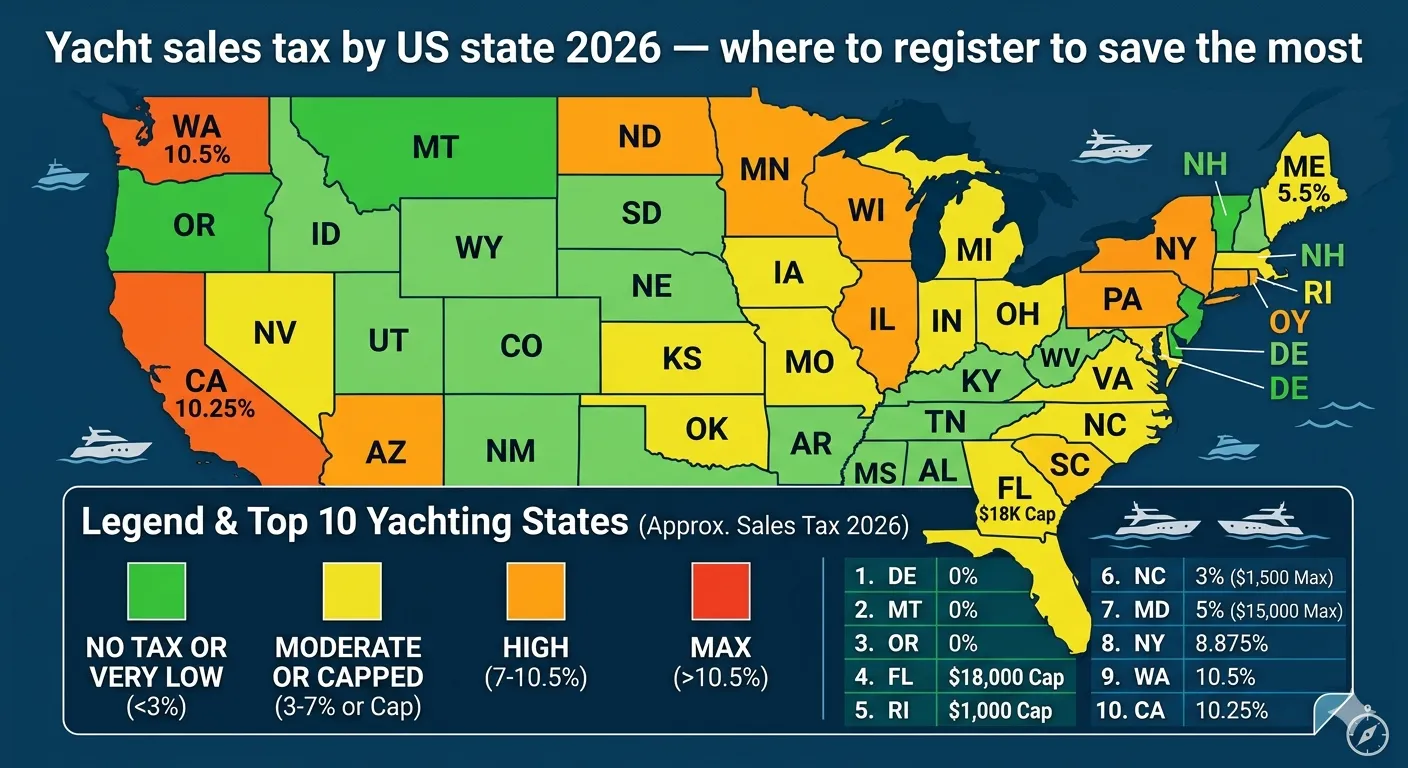
Color-coded US map showing yacht sales tax rates by state. Delaware, Montana, and Oregon offer 0% — Florida caps at $18,000 regardless of vessel value.
| State | Sales/Use Tax | Property Tax | Registration Fee | Best For |
|---|---|---|---|---|
| Delaware | 0% | None | $20-50/year | East Coast cruising |
| Alaska | 0% | None | $50-100/year | Pacific Northwest |
| Montana | 0% (via LLC) | None | $100-300/year | Complex structures |
| Rhode Island | $500 flat fee | None on transient | $500/year | New England base |
| Florida | 6% (cap $18K) | None | $200-500/year | Southeast cruising |
| New Hampshire | 0% | None | $50-150/year | New England inland |
| Oregon | 0% | None | $100-200/year | West Coast |
| California | 7.5-10.25% | 1-2% value | $300-800/year | Avoid if possible |
| New York | 4% + local | Varies | $250-600/year | Higher tax burden |
💡 The $300,000 Difference
On a $5M yacht: California charges $375K-512K in sales tax. Delaware charges $0. That's a $400,000+ difference for the same yacht.
Best States Detailed Analysis
🏆 Delaware: The Gold Standard
Sales Tax: 0%
Annual Cost: $20-50 registration
Advantages:
- Zero sales tax on any vessel purchase
- No property tax on boats
- Simple registration process
- Easy access to Atlantic cruising grounds
- Well-established yacht-friendly laws
- Close to major East Coast destinations
Requirements:
- Can register without residency
- Documentation filed with Delaware DMV
- Annual renewal required
- Must have valid US Coast Guard documentation
Tax savings on $10M yacht vs California: $750,000-$1,025,000
🌲 Alaska: Pacific Northwest Champion
Sales Tax: 0% (state level)
Annual Cost: $50-100
Advantages:
- No state sales tax
- No personal income tax
- No property tax on vessels
- Perfect for West Coast and Alaska cruising
- Marine-friendly regulations
Considerations:
- Some boroughs charge local sales tax (0-7%)
- Geographic limitations for year-round cruising
- Longer delivery if yacht is East Coast-based
🏔️ Montana LLC Strategy
Sales Tax: 0% (via LLC structure)
Annual Cost: $500-1,500 (LLC formation + maintenance)
How It Works:
- Form Montana LLC to purchase yacht
- LLC owns yacht, you own LLC
- Montana has 0% sales tax
- Used for yachts kept in other states
Warning:
Many states are cracking down on Montana LLC structures. California, New York, and others actively pursue use tax on Montana-registered vehicles/boats kept in-state. This strategy has significant legal risk and should only be pursued with expert legal counsel.
⛵ Rhode Island: The $500 Solution
Sales Tax: $500 flat fee (any vessel value)
Annual Cost: $500
Advantages:
- Flat $500 fee regardless of yacht value
- Perfect for New England cruising
- Simple documentation
- Strong marine infrastructure
- Yacht-friendly regulations
Savings on $10M yacht: $599,500 vs 6% tax ($600K)
🌴 Florida: Southeast Standard
Sales Tax: 6% capped at $18,000
Annual Cost: $200-500
Advantages:
- Tax cap at $18K means affordable for expensive yachts
- Best climate for year-round boating
- Extensive marina infrastructure
- Close to Caribbean
- Large yacht services industry
The Math:
- Yacht under $300K: Full 6% applies
- Yacht $300K-$10M: Only $18,000 tax (massive savings)
- $10M yacht: $18K tax = 0.18% effective rate
Why Florida is Popular: The cap makes it attractive for expensive yachts while providing excellent cruising grounds.
States to Avoid
California: Highest Yacht Tax Burden
- Sales tax: 7.5-10.25% (no cap)
- Property tax: 1-2% of assessed value annually
- $10M yacht cost: $750K-$1.025M sales tax + $100K-200K/year property tax
- Aggressive enforcement: California actively pursues out-of-state registered yachts
New York: Complex and Expensive
- Sales tax: 4% state + local (up to 8.875% NYC)
- Use tax: Applies if kept in NY waters >90 days
- Registration: $250-600 annually
- $10M yacht cost: $400K-887K sales tax
Strategic Tax Planning
The 90-Day Rule
Many states impose use tax if your yacht spends more than 90 days in their waters, even if registered elsewhere. Key strategies:
- Track days carefully: Document when yacht enters/exits state waters
- Plan cruising routes: Alternate between states
- Use professional captains: Crew movement doesn't count as "your" use in some states
- Understand exemptions: Some states exempt maintenance periods
⚠️ Use Tax vs Sales Tax
Sales tax: Paid at purchase in the state where bought. Use tax: Owed when you bring a yacht into a state for extended use. You can't escape both—if you register in Delaware but keep yacht in California 90+ days, California will pursue use tax. Plan accordingly.
Charter Operations Impact
If you plan to charter your yacht:
- Florida: Best for US charter operations, established market
- California: High tax but large charter market
- US Virgin Islands: Zero tax, excellent charter location
- Foreign flag: Consider Cayman/BVI for international charter
Documentation Requirements by State
Delaware Registration
- US Coast Guard documentation
- Bill of sale
- Delaware DMV registration form
- $20-50 fee
- No physical inspection required
Florida Registration
- Bill of sale with sales tax paid or exemption
- Coast Guard documentation OR state title
- Florida registration form
- Proof of insurance
- Physical inspection for first registration
Rhode Island Registration
- Coast Guard documentation
- Bill of sale
- $500 flat fee payment
- RI DMV registration
Real Examples: Tax Savings
Example 1: $5M Yacht
- California (8%): $400,000 sales tax
- Florida (cap): $18,000 sales tax
- Delaware: $0 sales tax
- Savings by choosing Delaware: $400,000
Example 2: $15M Yacht
- New York (8.875%): $1,331,250 sales tax
- Florida (cap): $18,000 sales tax
- Rhode Island: $500 flat fee
- Savings by choosing RI: $1,330,750
💰 Calculate Your Total Yacht Costs
State taxes are just one component. Get your complete cost breakdown including crew, maintenance, insurance, and dockage.
Use Free Calculator →Common Tax Mistakes to Avoid
- Ignoring use tax: Registering in Delaware but keeping yacht in California 100% of time
- Poor documentation: Can't prove days in each state when audited
- Montana LLC without counsel: High audit risk and penalties if wrong
- Assuming no tax burden: Even zero-tax states require registration and documentation
- Not planning for future moves: Moving yacht to different state can trigger new taxes
Professional Guidance Essential
Yacht taxation is complex with significant financial consequences. Before making decisions:
- Consult maritime tax attorney: Specializes in vessel taxation ($3K-8K consultation)
- Work with CPA experienced in yachts: Ongoing tax planning and filing
- Engage yacht management company: They handle compliance in your state
- Join yacht owner associations: Share knowledge and strategies
⚠️ Tax Evasion vs Tax Avoidance
Legal (tax avoidance): Registering in Delaware and genuinely using yacht in multiple states. Illegal (tax evasion): Claiming yacht is in Delaware when it's docked full-time in California. The difference is critical and the penalties for evasion are severe. Always ensure your strategy is legally sound.
Final Recommendations
For East Coast cruising: Delaware (zero tax) or Rhode Island ($500 flat) are excellent choices with strong legal backing.
For Florida-based: Florida's $18K cap is reasonable, plus you get best year-round climate and infrastructure.
For West Coast: Alaska (zero tax) if cruising Pacific Northwest, or consider Oregon (zero tax).
For nationwide flexibility: Delaware registration with careful tracking of days in each state to avoid use tax.
Avoid: California and New York unless you must be there, as their tax burden is 10-20× higher than alternatives.
The right state choice can save hundreds of thousands of dollars, making it one of the most important decisions in yacht ownership. However, compliance is critical—aggressive tax avoidance strategies often backfire when states audit and assess penalties. Work with professionals to find the optimal legal structure for your situation.