Fractional Yacht Ownership: Complete 2026 Guide
Quick Answer: What is Fractional Yacht Ownership?
Fractional yacht ownership means buying a 1/4, 1/8, or 1/12 share in a professionally-managed yacht, providing 6-12 weeks of usage annually at 60-75% lower cost than full ownership. You get the yachting experience without bearing 100% of operational expenses, capital investment, or management responsibilities. Annual costs: $150K-$400K vs. $1M+ for full ownership.
Fractional yacht ownership has evolved from a niche concept to a legitimate alternative for high-net-worth individuals who want the yachting lifestyle without the full financial burden or management headaches of solo ownership.
This guide explains how fractional ownership works, compares costs to full ownership and charter, reviews top programs, and helps you determine if shared ownership makes sense for your situation.
How Fractional Yacht Ownership Works
Think of fractional yacht ownership as a partnership where multiple owners share both costs and usage of a professionally-managed yacht.
Typical Structure
- Share sizes: Usually 1/4 (25%), 1/8 (12.5%), or 1/12 (8.33%)
- Annual usage: 6-12 weeks per year depending on share size
- Management company: Professional firm handles operations, crew, maintenance
- Usage scheduling: Fair allocation system balancing prime and off-peak seasons
- Exit strategy: Resale or buyback provisions after minimum holding period
What You Actually Own
In most fractional programs, you own a genuine equity stake in the yacht—not just usage rights. This typically means:
- Legal ownership percentage (via LLC or direct title)
- Proportional equity if yacht is sold
- Appreciation potential (or depreciation risk)
- Asset on your balance sheet
💡 Fractional vs. Boat Clubs
Fractional ownership means you own a specific yacht share and build equity. Boat clubs are membership-based access without ownership—you're essentially pre-paying for charter time. Fractional provides ownership benefits and potential appreciation; clubs offer more variety and flexibility.
Cost Comparison: Full vs. Fractional Ownership
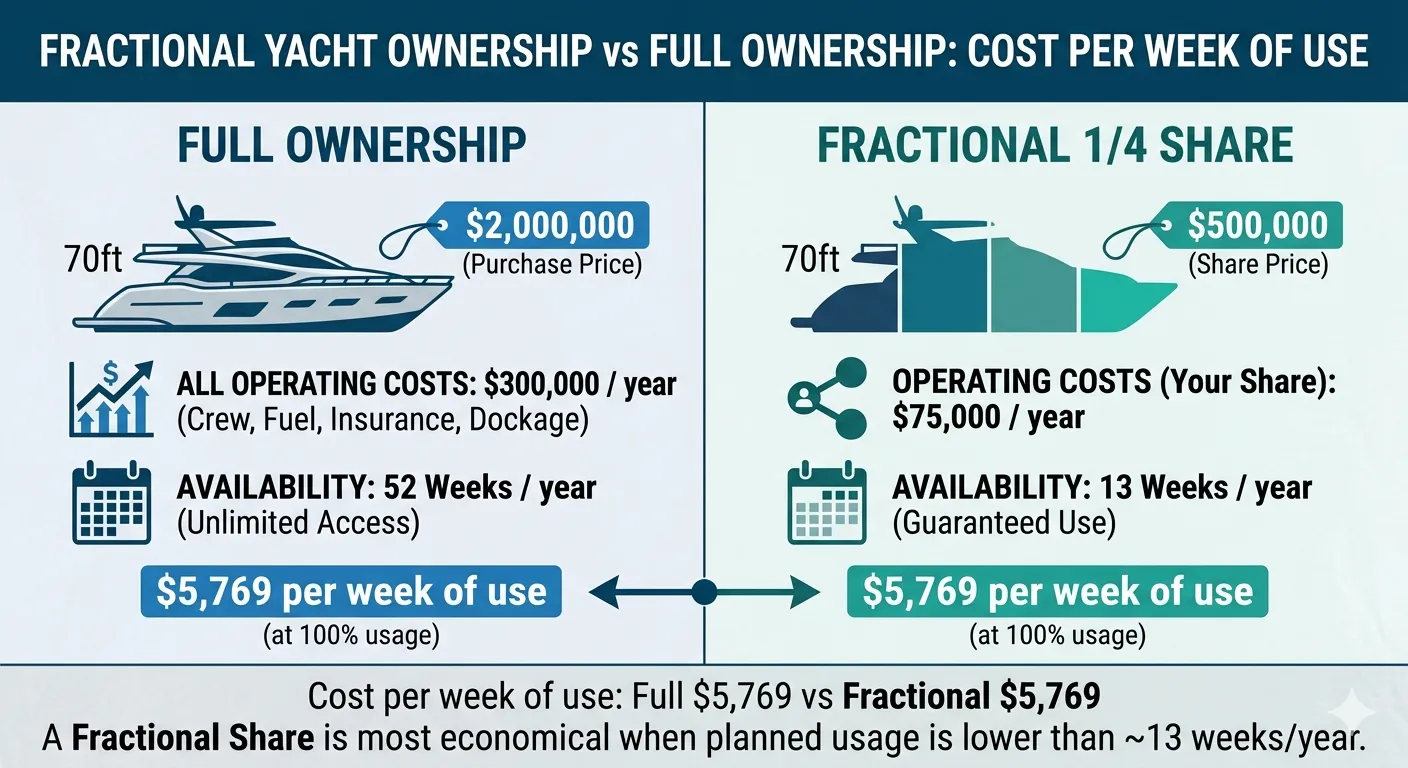
Cost per week of use is equal at 100% utilization — but fractional wins when your actual usage is below ~13 weeks per year.
Example: 100ft Motor Yacht Valued at $10M
| Ownership Type | Initial Investment | Annual Cost | Usage Weeks | Cost Per Week |
|---|---|---|---|---|
| Full Ownership | $10,000,000 | $1,300,000 | 52 (available) | $25,000 |
| 1/4 Share (25%) | $2,500,000 | $325,000 | 13 weeks | $25,000 |
| 1/8 Share (12.5%) | $1,250,000 | $162,500 | 6-7 weeks | $23,214 |
| Weekly Charter | $0 | $120,000 (1 week) | 1 week | $120,000 |
| Weekly Charter | $0 | $960,000 (8 weeks) | 8 weeks | $120,000 |
Key Takeaways:
- 1/8 share saves $1.14M annually vs. full ownership (88% savings)
- Break-even vs. charter: 6-7 weeks usage (1/8 share matches charter cost)
- Capital efficiency: $1.25M investment vs. $10M for similar experience
- Per-week cost: Fractional matches full ownership (~$25K/week)
Complete Fractional Ownership Cost Breakdown
One-Time Costs (1/4 Share, $10M Yacht Example)
| Expense | Amount |
|---|---|
| Share purchase price | $2,500,000 |
| Legal & documentation fees | $15,000-25,000 |
| Initial provisioning deposit | $10,000-15,000 |
| Total Initial Investment | $2,525,000-$2,540,000 |
Annual Operating Costs (1/4 Share)
| Expense | Annual Cost |
|---|---|
| Proportional operating expenses | $250,000 |
| Management fee (10-15% of ops) | $40,000 |
| Refit reserve contribution | $12,500 |
| Fuel & provisioning (usage-based) | $20,000 |
| Miscellaneous (insurance, admin) | $2,500 |
| Total Annual Cost | $325,000 |
Real Example: 1/8 Share Cost Analysis
Yacht: 95ft Azimut, Caribbean-based
Share purchase: $1,400,000 (1/8 of $11.2M)
- Annual operating contribution: $162,000
- Management fee: $24,000
- Usage-based costs (fuel/provisions): $18,000
- Total annual: $204,000 for 7 weeks usage
- Effective cost per week: $29,143
Comparison: Chartering the same yacht costs $85,000/week. After 3 weeks, fractional ownership becomes cheaper on a per-week basis.
Advantages of Fractional Ownership
✅ Financial Benefits
- 60-75% lower capital requirement
- Proportional operating costs only
- Equity appreciation potential
- Tax deductions (proportional)
- Predictable annual budgeting
- Exit liquidity through resale
✅ Lifestyle Benefits
- Yacht available 6-13 weeks/year
- Professional management included
- No hiring/managing crew
- Maintenance handled for you
- Familiar yacht (not different each time)
- Prime season access guaranteed
Disadvantages & Risks
⚠️ Usage Limitations
- Limited to allocated weeks
- Scheduling coordination required
- Peak season may be restricted
- Can't use spontaneously
- Geographic restrictions possible
⚠️ Partnership Risks
- Decisions require co-owner agreement
- Shared financial responsibility
- No customization control
- Resale depends on market
- Management company performance matters
Top Fractional Yacht Programs 2026
YachtPlus Fractional
- Fleet: 80-120ft motor yachts, Mediterranean & Caribbean
- Share sizes: 1/4, 1/8, 1/12
- Typical cost: $150K-400K annually
- Advantages: Established program, fleet diversity, strong resale market
SeaNet Yachts
- Fleet: 70-110ft yachts, primarily US East Coast
- Share sizes: 1/6, 1/8, 1/10
- Typical cost: $120K-350K annually
- Advantages: Lower entry cost, flexible scheduling, includes captain
Oyster Yachts Fractional
- Fleet: 80-125ft sailing yachts, worldwide
- Share sizes: 1/4, 1/6
- Typical cost: $200K-500K annually
- Advantages: Sailing focus, rally events, strong community
⚠️ Due Diligence Essential
Not all fractional programs are created equal. Key questions before buying:
- What's the management company's track record? (Check references)
- How are operating costs audited and controlled?
- What's the reserve fund status for major refits?
- What are the exit provisions and typical resale timeframes?
- Have any co-owners left? Why?
- What happens if the yacht is damaged or needs major repair?
Who Should Consider Fractional Ownership?
Ideal Candidates
- Usage pattern: You want 6-12 weeks of yachting annually, not 20+ weeks
- Financial profile: You can afford full ownership but prefer capital efficiency
- Management preference: You want turnkey yachting without operational headaches
- Geographic focus: Your cruising grounds align with fractional fleet locations
- Flexibility mindset: You're comfortable with scheduling coordination and shared decisions
Poor Fit For
- Heavy users: If you want 15+ weeks, full ownership becomes more economical
- Control seekers: Those who want complete customization and spontaneous use
- Specific needs: Specialized operations (diving, fishing, charter) may require dedicated yacht
- Geographic mismatch: If you cruise regions not served by fractional programs
Fractional vs. Charter: The Break-Even Analysis
When Does Fractional Beat Charter?
Scenario: 100ft yacht, $120,000/week charter rate vs. 1/8 fractional share
Fractional ownership (1/8 share):
- Initial investment: $1,250,000
- Annual operating cost: $162,500
- Usage: 6-7 weeks per year
- Effective cost per week: ~$23,000
Charter alternative:
- No initial investment
- Cost per week: $120,000
- 6 weeks annual: $720,000
Analysis:
- Year 1: Charter cheaper (no capital outlay)
- Year 2: Fractional pulls ahead ($162K vs $720K annually)
- 5-year total: Fractional: $2.06M (including capital). Charter: $3.6M
- Break-even: 3-4 weeks annual usage makes fractional attractive vs. charter
Conclusion: If you yacht 4+ weeks annually, fractional ownership typically delivers better value than repeated chartering—plus you build equity.
💰 Compare All Ownership Options
Use our calculator to compare full ownership, fractional, charter, and boat clubs for your specific usage pattern and budget.
Calculate Your Best Option →Exit Strategy & Resale Market
A critical consideration often overlooked: how do you exit fractional ownership?
Typical Exit Provisions
- Minimum hold period: Usually 3-5 years before resale allowed
- Right of first refusal: Co-owners get first chance to buy your share
- Management company buyback: Some programs guarantee buyback at percentage of market value
- Independent sale: You can market to outside buyers (but they must be approved by co-owners)
- Forced sale triggers: If yacht reaches certain age or condition, fleet is liquidated
Resale Reality
The fractional yacht resale market is less liquid than full yacht sales. Expect:
- Sale timeframe: 6-18 months typical
- Pricing: 10-20% discount to proportional yacht value common
- Buyer pool: Limited to those interested in that specific program and yacht
- Depreciation: Shares depreciate in line with yacht value (5-8% annually)
💡 Treat Fractional as Long-Term
Don't buy a fractional share if you might need liquidity in 1-2 years. The 3-5 year minimum hold plus 6-18 month sale process means your capital is locked up for 4-7 years realistically. Plan accordingly.
Tax Considerations
Fractional yacht ownership creates complex tax situations requiring professional guidance:
Potential Tax Benefits
- Depreciation deductions: Proportional to your ownership percentage
- Operating expense deductions: If qualifying business use
- Interest deductions: If financed, proportional interest may be deductible
- Capital loss: If selling at a loss, may offset other capital gains
Tax Complications
- Partnership taxation: LLC structure may require K-1 tax forms
- State taxation: May owe tax in state where yacht is registered or located
- Charter income: If yacht is chartered when you're not using it, proportional income taxed
- Personal use limitations: IRS limits on business deductions for recreational vessels
⚠️ Professional Tax Advice Required
Yacht taxation is specialized and fractional ownership adds complexity. Consult with CPAs who specialize in maritime and partnership taxation. Poor tax planning can erase financial advantages of fractional ownership.
Final Verdict: Is Fractional Right for You?
Fractional ownership makes sense when:
- You want 4-12 weeks of yachting annually (the sweet spot for value)
- You prefer capital efficiency over 100% control
- You value professional management and turnkey operations
- You're comfortable with collaborative decision-making
- Your cruising aligns with available fractional fleets
- You can commit to 5+ year ownership horizon
Full ownership is better when:
- You want 15+ weeks annual usage or year-round availability
- You need complete control and customization
- You operate commercially (charter) and want 100% revenue
- You have specific operational requirements not met by fractional programs
- Capital appreciation and asset control matter more than usage cost efficiency
Charter is better when:
- You yacht fewer than 3 weeks annually
- You want variety (different yachts, destinations)
- You prefer zero capital commitment and maximum flexibility
- You're testing whether yachting is right for you long-term
For the right person, fractional yacht ownership delivers 70-80% of the full ownership experience at 25-40% of the cost. It's an elegant solution for high-net-worth individuals who want the yachting lifestyle without bearing the full financial and operational burden.
The key is honest self-assessment of your usage patterns, control needs, and financial priorities. If you're in that 6-12 week usage range and value capital efficiency, fractional ownership deserves serious consideration.