Yacht Cost in Monaco, France: Annual Ownership Expenses (2026)
A 100ft motor yacht based in Monaco costs approximately $3,541,750/year to operate — or $295145/month. This is based on local marina rates of $350/ft/month and diesel at $7.5/gallon. The estimate covers crew, maintenance, insurance, fuel, dockage, and operating expenses. Use the calculator below to get a personalised figure for your vessel.
Annual Cost Breakdown: 100ft Motor Yacht in Monaco
The following breakdown is based on a 100ft motor yacht valued at approximately $15 million, operating year-round in Monaco with 200 engine hours annually and a crew of 6–7.
| Cost Category | Annual Amount | Key Driver |
|---|---|---|
| Crew salaries & benefits | $790,625 | Captain + 5–6 crew + chef |
| Maintenance & repairs | $1,690,000 | 11% of vessel value |
| Insurance (worldwide) | $315,000 | 1.5% × 1.4 range multiplier |
| Dockage (12 months) | $420,000 | $350/ft/month in Monaco |
| Fuel (200 engine hours) | $112,124 | 65 GPH × $7.5/gal incl. generator |
| Provisioning & supplies | $150,000 | 60 cruising days, full crew |
| Management, comms & legal | $189,000 | Management, sat comms, registration |
| Total annual operating cost | $3,081,322 – $4,002,177 | 23.6% of vessel value |
Marina Rates in Monaco
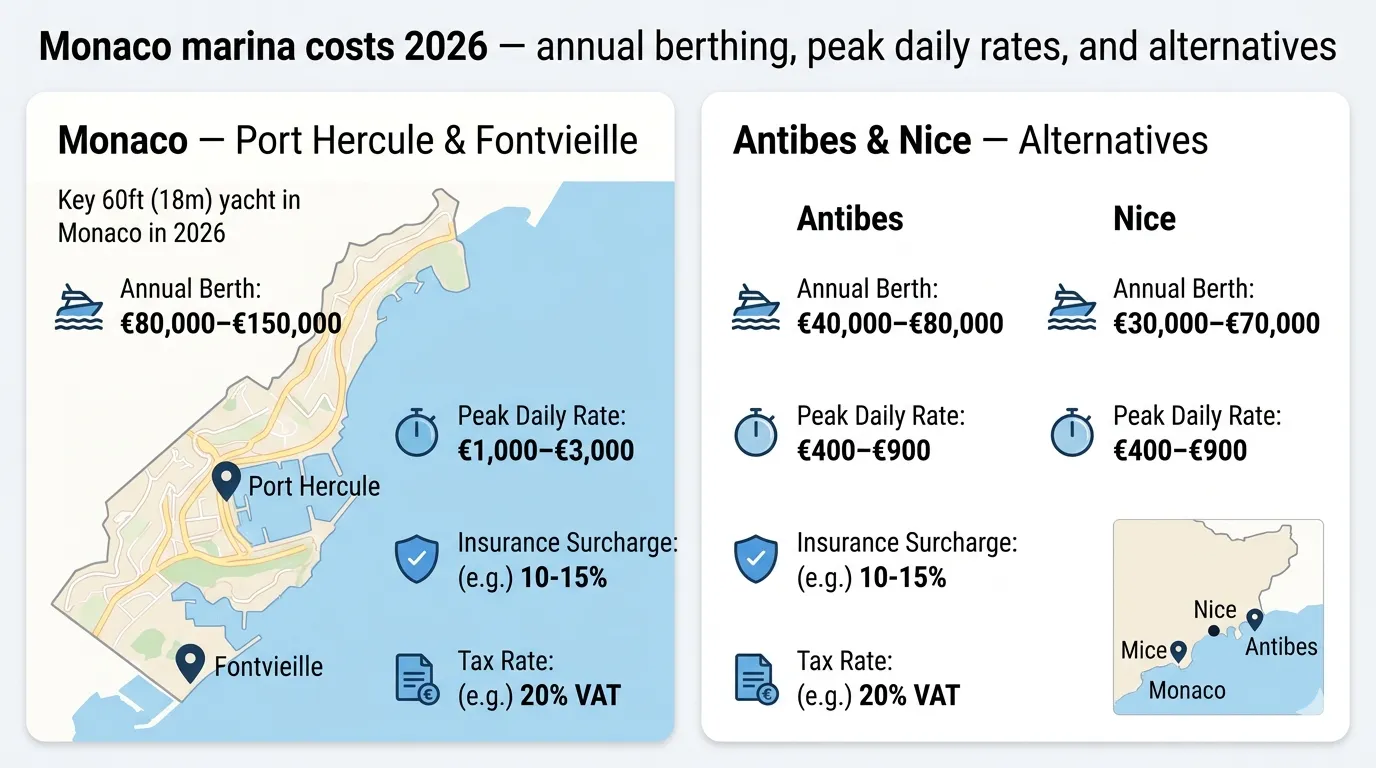
Monaco marina rates vs nearby alternatives — Port Hercule annual berthing is 2-4x more expensive than Antibes or Nice for the same vessel.
Monaco's Port Hercule is the world's most prestigious — and expensive — marina, with berths allocated by size and prestige. The Monaco Yacht Show each September is the premier superyacht event globally. The Principality's 2km² coastline limits supply, driving rates to €300–€600/ft/night for prime berths in peak season.
At $350/ft/month, a 100ft yacht pays $35,000/month or $420,000/year in dockage alone. Shorter stays (transient rates) are typically 30–50% higher per day than monthly contracts. Most owners negotiate annual agreements for the best rates.
Fuel Costs in Monaco
Marine diesel in Monaco averages $7.5/gallon in 2026. A 100ft motor yacht consuming 65 gallons per hour runs approximately $487 per engine hour. At 200 annual engine hours plus generator and tender fuel, total annual fuel spend is approximately $112,124.
Tax & Registration: Monaco
📋 Tax summary for Monaco, France
EU VAT via Temporary Admission (18-month window). Consult a qualified marine tax advisor for your specific situation — tax treatment varies significantly based on vessel flag state, owner residency, and usage pattern.
Operating Season in Monaco
Peak operating season: Jun–Sep peak. The Mediterranean commands the highest dockage rates globally — particularly Monaco and the French Riviera in peak season. EU VAT (20–25%) applies to vessels spending extended time in EU waters, though Temporary Admission allows non-EU owners to cruise for up to 18 months without triggering VAT. Charter rates are 20–40% higher than the Caribbean, making the Med the preferred region for charter programmes.
Calculate for Your Specific Yacht in Monaco
The figures above are for a 100ft motor yacht. Enter your vessel's length and value to get an accurate annual estimate adjusted for Monaco's local rates.
Open Calculator Pre-filled for Monaco →Port Hercule 2026: Official Rate Structure
Port Hercule is operated by the Société d'Exploitation des Ports de Monaco (SEPM). The 2026 official tariff distinguishes between low season (January–April and October–December) and high season (May–October). For a 100ft / 30.5-metre motor yacht, the official 2026 monthly rates are approximately €4,500–€7,100/month depending on season — roughly €14–€23/ft/month at the official Port Hercule tariff. However, private berth holders and long-term leaseholders pay substantially different (generally lower) rates negotiated directly with SEPM, and the waiting list for a permanent berth runs many years.
| Port | Character | Low Season (30m yacht) | High Season (30m yacht) |
|---|---|---|---|
| Port Hercule | City centre, F1 track views, 700 berths | €4,508/month | €7,066/month |
| Port de Fontvieille | Industrial/residential area, smaller craft | Lower rates than Hercule; limited superyacht berths | |
| Port Cala del Forte | Newest port (2021), Italian border, 175 berths | 2026 rates per official SEPM tariff | |
Source: SEPM official 2026 tariff (ports-monaco.com). Figures shown are all-inclusive (TTC/VAT included at 20%). Rates apply to short-term passage berthing; annual private berth holders negotiate separately. 1 month = 1st to 30th/31st.
The Monaco Grand Prix Premium
The Formula 1 Monaco Grand Prix, held each May, triggers a completely separate rate structure. SEPM publishes a dedicated Grand Prix tariff annually. For 2025, berths at Quai des États-Unis (trackside, Zone 1) for a 100–110 metre vessel were priced at approximately €129,990 including VAT for the race week period. For smaller yachts in Zone 2 and Zone 3, prices started from €20,000–€50,000 for yachts up to 25 metres.
The Grand Prix week premium applies from the Monday before the race through the Monday following. During this window, any mooring in Port Hercule — regardless of duration — triggers the Grand Prix tariff. Berths must be reserved well in advance; the most desirable trackside positions are allocated through SEPM's formal application process, often to the same returning clients year after year.
For owners who wish to attend but cannot secure a Hercule berth, adjacent ports like Antibes (45nm west) and Beaulieu-sur-Mer (10nm east) are common alternatives, with tender or helicopter service to the circuit.
Monaco Yacht Show: September's Superyacht Season Finale
The Monaco Yacht Show (MYS), held each September in Port Hercule, is the world's premier superyacht charter and sales event, displaying vessels typically 24 metres and above. For the five-day show period, Port Hercule is largely allocated to exhibiting yachts and invited charter brokers. Non-exhibiting yachts are typically asked to relocate to Antibes, Villefranche, or anchorage. Show-adjacent dockage at Port Cala del Forte and Port de Fontvieille fills within days of the show announcement.
Owners whose yacht is being shown at MYS can generate significant visibility — central berths during the show are seen by the world's largest congregation of superyacht buyers, brokers, and charter clients. Many charter bookings are initiated at MYS for the following season.
Monaco's Tax Advantages for Yacht Owners
Monaco imposes no personal income tax on residents (with the exception of French nationals). This is the fundamental reason many yacht owners establish Monaco residency: income from charter operations, dividends from yacht-holding structures, and capital gains on vessel sales are not taxed at the personal level for Monaco residents. The Principality also applies a reduced VAT rate on marine fuels compared to metropolitan France.
However, the route to Monaco residency is well-defined and requires genuine ties: a Monaco address (minimum studio apartment, which starts at €3,000–€6,000/month), a bank account with a Monaco bank holding a meaningful deposit (typically €500,000+), and a clean criminal record. EU nationals have a straightforward route; non-EU nationals require an apostille-certified visa from the Monaco Government.
Flag state is a separate question from owner residency. Most superyachts based in Monaco fly the flag of a flag of convenience jurisdiction — Cayman Islands, Marshall Islands, or Malta (EU) — which affects crew visa rights, port state control inspections, and charter licensing. A qualified superyacht attorney should advise on the optimal ownership and flag state structure for your specific situation.
Fuel Costs in Monaco and the Côte d'Azur
Marine diesel on the Côte d'Azur in 2025–2026 averages €1.70–€2.10/litre (approximately $7.00–$8.60/US gallon) depending on the port and quantity. Port Hercule's own fuel dock is convenient but not the most competitive; several fuel barges and delivery services in Antibes and Nice offer better pricing for bulk quantities. A 100ft motor yacht consuming 65 gallons per hour at 200 engine hours annually would spend approximately €90,000–€110,000 on fuel operating from Monaco — roughly 2.5–3× the equivalent cost in Florida.
Lubricants, filters, and engine consumables also carry a European premium of 30–50% over US prices, as the entire Mediterranean service supply chain is shorter and less competitive than Florida's. Owners who spend summer in the Mediterranean and winter in Florida increasingly purchase major supplies and spares in Florida for shipment to their European base.
Crew Costs and Mediterranean Operations
MYBA (Mediterranean Yacht Brokers Association) sets the de facto benchmark for crew wages on commercially licensed yachts in the Mediterranean. A captain on a 30m–35m (100ft–115ft) vessel earns approximately €6,500–€8,500/month under MYBA standards, with a full crew of 6–7 adding another €15,000–€22,000/month in aggregate salaries. These figures are broadly comparable to Florida rates when exchange rates are neutral, but crew social security contributions (charges patronales) required by French law for France-flagged yachts or yachts operating substantially in French waters can add 40–50% to direct salary costs.
Cayman Islands and Marshall Islands flag states avoid French social security requirements, which is one reason the vast majority of Monaco-based superyachts carry these flags rather than French or Monegasque registration.
Monaco as a Yacht Owner Residence: Legal and Financial Considerations
Monaco's appeal to yacht owners extends well beyond its marina. The principality levies no personal income tax on residents (with the exception of French nationals), no capital gains tax, and no wealth tax. For high-net-worth individuals who own yachts as part of a broader asset portfolio, establishing Monaco residency can generate tax savings that significantly exceed the cost of yacht ownership itself. This is not theoretical — a substantial percentage of superyachts over 60 metres are beneficially owned by Monaco residents.
Residency requirements are straightforward but financially demanding. Applicants must demonstrate the ability to support themselves in Monaco — typically evidenced by a minimum bank deposit of €500,000 at a Monaco-based bank (though the actual threshold varies and is not formally published) and a lease on a Monaco apartment (minimum rents for qualifying properties start at approximately €5,000–€8,000 per month for a studio or one-bedroom). The total commitment — apartment, deposit, and associated costs — typically runs €150,000–€200,000 per year before lifestyle expenses.
For yacht structuring purposes, Monaco residency simplifies several aspects of ownership. A Monaco-resident owner can hold a yacht through a personal name or a Monaco SAM (Société Anonyme Monégasque) without the layers of offshore structures that non-resident owners often require. Insurance, banking, and management services are all available locally through Monaco-based firms with deep yacht industry expertise — companies like Fraser, Burgess, and IYC all maintain Monaco offices specifically for this clientele.
The combination of residency benefits and yacht ownership creates a synergy that explains Monaco's outsized presence in the global superyacht market. For a vessel valued at €15–50 million, the tax savings from Monaco residency versus a French, UK, or Italian tax domicile can easily exceed €1 million annually — dwarfing the operating costs of the yacht itself and effectively making ownership a net-positive financial decision for some ultra-high-net-worth individuals.
Day-to-Day Berthing Reality: Living Aboard in Port Hercule
Port Hercule is not a marina in the conventional sense — it is a working harbour in the centre of one of the world's most densely populated territories. This creates a unique set of daily operational realities that owners and captains must accommodate. Space is extremely limited: the harbour accommodates approximately 700 berths, and demand permanently exceeds supply. Berth allocation is controlled by the Société d'Exploitation des Ports de Monaco (SEPM), and securing a permanent annual berth requires either a long wait list or purchasing a berth licence from an existing holder — transactions that can cost €50,000–€150,000 per metre of berth length, independent of the actual mooring fees.
Noise and activity levels in Port Hercule are high. The harbour sits directly below Monaco's main road (Quai Albert Ier), and traffic, construction, and event preparation create a constant background. During the Grand Prix (late May), the yacht becomes part of a stadium — circuit barriers are erected metres from the quay, and the noise during race weekend is extraordinary. Some owners embrace this as a unique spectacle; others relocate to Fontvieille or Cap d'Ail for the duration.
Shore power in Port Hercule is reliable and metered — a significant advantage over many Mediterranean ports where generators must run continuously. Water quality in the harbour itself is a known issue; while it has improved substantially over the past decade, the enclosed nature of the port means water circulation is poor, and hull fouling rates are higher than in open-water marinas. Most yachts based permanently in Port Hercule schedule hull cleaning every 4–6 weeks rather than the 8–12 week cycle typical in better-flushed ports.
Security is excellent — Monaco's police-to-resident ratio is the highest in the world, and the harbour is under continuous CCTV surveillance. Theft and vandalism are virtually non-existent, which allows yachts to operate with less stringent onboard security protocols than they might in less controlled environments. For owners who travel frequently and leave their yacht unmanned for periods, this is a meaningful operational advantage.
How Monaco Compares
Compared to other major yacht bases, Monaco sits in the Mediterranean region at $350/ft/month dockage and $7.5/gal diesel. Caribbean destinations like Nassau or Tortola are cheaper (dockage from $28/ft/month, diesel ~$5.50/gal), while French Riviera ports like Antibes cost significantly more ($140–$350/ft/month, diesel €6.50–€7.50/litre). See our full Mediterranean vs Caribbean cost comparison.